Using AI for code, but not for art? This is for you.
AI discourse is absolutely devouring the online world right now. Is it tears through my communities, I am forced to see how my friends and acquaintances are dealing with it, and whether they take a pro-AI, or anti-AI stance.
Many of them are anti-ai-absolutists. They complain that one token is too much, and that House House should be disowned for their usage of LLMs. Others are quite pro-AI, and are actively paying for Claude max subscriptions and vibe-coding projects. One even used Claude to make ad-free clones of his favorite mobile games…
But these are extremes.
By far the most popular stance is that AI is OK for some tasks, but not OK for others. Frustratingly, the line currently tends to get drawn roughly between “Programming” and “Everything else”.
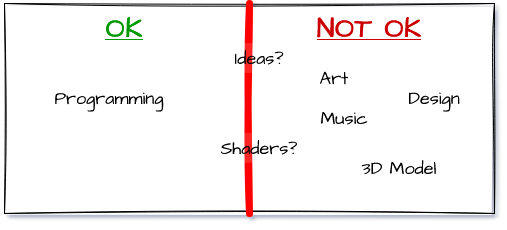
I would like to argue that this is a stupid line. Actually I will just say it: That’s a really stupid line.
The Line
Absolutists on both sides will argue that we don’t need a line. Either because they see no ethical usage of AI, in any context, or they don’t respect that AI has any ethical concerns at all, and want to vibeslop everything. This article however assumes that there is a line, and that we need to find it.
I have spoken with artists who are vibe-coding their games, but creating all the art from scratch. When asked, they tend to find it quite insulting when people use AI art in games, and yet they’re OK vibecoding. What’s the catch?
Ignoring the moral black hole of “if I can’t do it, it’s OK to use AI”, I think these creative types are OK vibe-coding their games because they don’t think of programming as creative.
Programmers tend to disagree, and I will show you why.
Limitations Make the Game
When programming something by hand, your project will be constrained by the practical realities of human effort. Every system and feature needs to be weighed against the cost and complexity of building it. As your game progresses, the design will change as you discover and overcome technical limitations -just like your art direction does. The dialogue between tech, design, and art as the game developers is what results in a refined and sharp experience.
If every feature is just a prompt away, you will never stop and ask yourself:
- Does adding this feature improve the project?
- Is there a better way to do this?
- Could this feature be done another way?
The industry is full of stories showing how limitations breed creativity. For example the famous fog from silent hill was done for technical reasons, not artistic reasons. Working through problems as a team is a feature, not a bug.
“Perfection is achieved, not when there is nothing more to add, but when there is nothing left to take away.” – Antoine de Saint-Exupéry
Code isn’t Code
A popular form of vibe-coded content is creating projects with no assets e.g., “everything is generated by code with WebGPU (no images, models or sound files), all in a single 97 KB HTML file.”.
This is just code. If you gave a programmer enough time, it would be possible to create something like this by hand, without ever sculpting a single model.
You know what else is just code? Shaders. And the behavior trees for enemy logic. And for procedural worlds, the world itself.
Even if you put an iron fence around sounds, 3D models, animations and textures, so much of the games content, feel, and identity comes from how it was programmed. Removing programmers from the loop because it’s not ‘creative work’ is short sighted and intellectually dishonest.
My Line
If we’re going to be using AI, we can’t be throwing entire disciplines into the ‘OK’ category. As a team, you need to decide what level of AI assistance you’re comfortable with, and then stick to that across disciplines.
Tools like ‘content aware fill’ or ‘google docs auto-complete’ can be measured up against ‘IDE smart-intellisense’. Vibe-coding can be measured up against Meshy3D and Sunno.
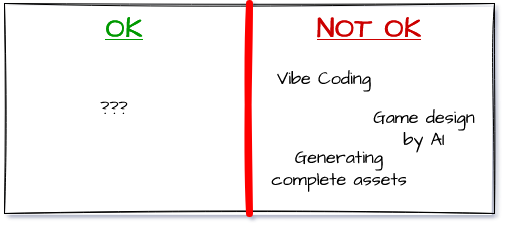
It’s also absolutely defensible to put everything in the “NO” category. Games were made for decades without LLMs, and it’s just as possible to do that in 2026 as it ever was.
Now go forth and make great stuff!